Exercise Guide
Forget traditional crunches. To achieve a truly flat, high-tension midsection, you must master the art of posterior stabilization.
Expert Clinical Insight: By utilizing a wall as a fixed kinetic anchor, we eliminate momentum and force the transverse abdominis (TVA)—your body’s natural inner corset—to work in an isometric and functional capacity. This protocol is designed to maximize intra-abdominal pressure, effectively “pulling in” the waistline while safeguarding the lumbar spine. 6 Essential Core Wall :Modalities
1. The Isometric Wall Sit

TVA & Global Stability
- Position your spine flush against the wall, feet 18 inches forward.
- Lower into a 90-degree knee bend, thighs parallel to the deck.
- The Key: Actively press your lumbar spine into the wall, eliminating any gap.
- Engage your navel toward your spine to activate the deep core.
The Professional Rationale: This creates a powerful isometric hold that forces the core to stabilize the spine against a massive lower-body torque. It builds “structural tension” that tightens the belly.
Duration: 3 sets of 60 seconds
2. Incline Wall-Anchored Climbers

Rectus Abdominis & Cardio-Metabolic
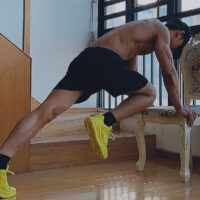
- Assume a high plank position with feet anchored against the base of the wall.
- Maintain a perfectly linear kinetic chain from heels to crown.
- Drive your knee toward the chest with explosive intent, using the wall for counter-balance.
- Control the return to ensure the hips do not pike or sag.
The Professional Rationale: The wall anchor increases the stability demand on the shoulders and lower abs, forcing the “six-pack” area to fire more intensely than a standard floor climber.
Duration: 3 sets of 45 seconds
3. Vertical Hollow-Body Push-Ups

Pectorals, Triceps & Core Bracing
- Stand at arm’s length from the wall, palms at shoulder height.
- Perform a “hollow body” tuck—squeeze your glutes and pull your ribs down.
- Lower with elbows at a 45-degree angle to protect the glenohumeral joint.
- Push back while maintaining total midsection rigidity.
The Professional Rationale: By focusing on the hollow-body position during the push, we transform an upper-body move into a standing plank, cinching the waist under load.
Volume: 3 sets of 25 reps
4. Wall-Supported Posterior Bridges

Glute-Ham Tie-in & Lower Abs
- Lie supine with feet flat on the wall, knees at 90 degrees.
- Drive through the mid-foot to elevate the pelvis into a bridge.
- Focus on a posterior pelvic tilt at the top to isolate the lower abs.
- Descend slowly, feeling each vertebra touch the floor sequentially.
The Professional Rationale: This modality corrects anterior pelvic tilt (the “pooch” look) by strengthening the glute-ab connection, leading to a flatter lower abdominal profile.
Volume: 3 sets of 15 reps
5. Wall-Assisted Stability Lunges

Unilateral Power & Obliques
- Stand with your side or back near the wall for balance.
- Execute a deep forward lunge, keeping the torso strictly vertical.
- Use the wall for minor tactile feedback to ensure your hips stay perfectly square.
- Press through the front heel to return, exhaling to tighten the core.
The Professional Rationale: Removing the fear of falling allows for a deeper range of motion, which increases the eccentric load on the hip flexors and deep core stabilizers.
Volume: 3 sets of 20 per leg
6. 90-Degree Vertical Leg Crunches

Upper Abdominal Isolation
- Hips close to the wall, legs extended vertically.
- This position “deactivates” the hip flexors, forcing the abs to do the work.
- Lift your shoulder blades by sliding your ribs toward your pelvis.
- Maintain a space between your chin and chest to protect the cervical spine.
The Professional Rationale: Having the legs vertical against the wall protects the lower back from arching, making this the safest and most effective way to target the upper rectus abdominis.
Volume: 3 sets of 20 reps