Exercise Guide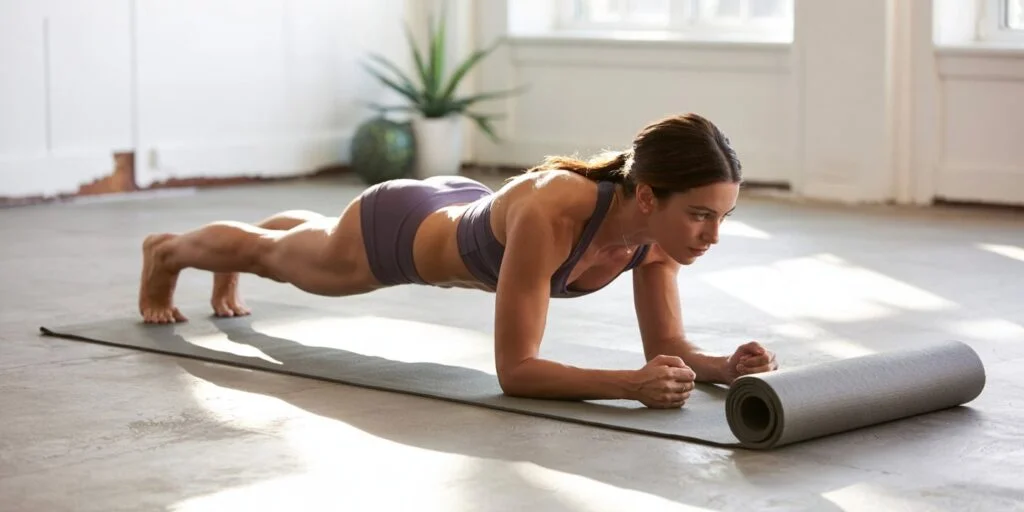
If you’ve ever wondered how to get a rock-solid, sculpted core without endless crunches, the secret often comes down to the plank. A plank is a full-body exercise disguised as a core move, targeting your abs, obliques, lower back, shoulders, glutes, and legs. This guide provides a complete roadmap to mastering the plank, from beginner variations to advanced challenges.
1 – How to Do a Plank: Proper Form & Common Mistakes

Proper form is essential to maximize benefits and prevent injury, especially to the lower back.
Step-by-Step: How to Do a Forearm Plank
- Start by lying face-down on a mat.
- Place your forearms on the floor with your elbows directly under your shoulders and your hands facing forward, shoulder-width apart.
- Lift your hips off the floor, keeping your back flat. Your body should form a straight line from your head to your heels.
- Engage your core by pulling your belly button in towards your spine (imagine bracing for a punch). Squeeze your glutes and quads to keep your legs straight.
- Keep your neck neutral by looking down at the floor, not up or forward.
- Hold this position for your desired time (e.g., 10–60 seconds).
Common Mistakes to Avoid:
- Sagging Hips: This is the most common mistake. It means your core is not engaged and puts significant strain on your lower back. If your hips sag, stop the hold and reset.
- Arched Back (Hips Too High): Lifting your butt in the air takes the tension off your abs and puts it on your shoulders. Keep your back flat.
- Head Lifted or Dropped: Looking up or letting your head drop strains your neck. Your head should be a neutral extension of your spine.
- Holding Breath: Breathe steadily throughout the hold. Holding your breath can increase blood pressure and reduce stability.
2 – Plank Exercise Benefits: 10 Reasons to Start Today

Planks are much more than an ab exercise. Their benefits include:
- Builds total core strength (abs, obliques, and spinal stabilizers).
- Improves posture and spinal alignment by strengthening the muscles that support your spine.
- Reduces lower back pain by building core strength that takes pressure off the back.
- Enhances athletic performance in other exercises like squats, deadlifts, and push-ups.
- Boosts balance, coordination, and functional strength for daily movements.
- Targets multiple muscle groups simultaneously (shoulders, glutes, quads).
- Increases shoulder and upper-body stability.
- Enhances flexibility in the posterior chain (hamstrings, arches of feet).
- Burns calories (up to 2–5 per minute, depending on weight and effort).
- Adaptable for all fitness levels, from absolute beginners to advanced athletes.
3 – Plank Variations for All Fitness Levels

Planks for Beginners: Start Here
If a standard plank is too challenging, build foundational strength with these modifications:
- Knee Plank: Perform a standard plank but with your knees on the ground. This reduces the load on your core while you build strength.
- Incline Plank: Place your hands or forearms on an elevated surface like a bench, sturdy table, or wall. The higher the surface, the easier the exercise.
- Tabletop Plank (Bear Plank): Start on your hands and knees. Engage your core and lift your knees just one inch off the floor. Hold.
Start with 3 sets of 10–20 second holds, 3–4 times per week.
Advanced Plank Variations for Core and Cardio
Once you’ve mastered the basic plank, challenge yourself with these dynamic versions:
- Plank with Leg Lift: In a plank, slowly lift one leg 6-8 inches off the floor without letting your hips tilt. Hold for 2 seconds, lower, and switch legs. This boosts glute and hamstring activation.
- Plank with Arm Lift: From a plank, slowly lift one arm straight out in front of you. This seriously challenges your balance and shoulder stability.
- Side Plank: Lie on your side, propped up on one elbow, with your hips lifted to form a straight line. This targets the obliques (love handles).
- Plank Jacks: In a high plank (on your hands), jump your feet wide and then back together, similar to a jumping jack. This adds a cardio element.
- Plank Shoulder Taps: In a high plank, slowly tap your left shoulder with your right hand, then your right shoulder with your left hand. The key is to keep your hips perfectly still.
4 – Planks for Weight Loss: How Long & How Many?

How Long to Hold a Plank?
Focus on quality of form over duration. A 20-second plank with perfect form is better than a 90-second plank with sagging hips.
- Beginners: Aim for 20–30 seconds per set.
- Intermediate: Aim for 45–60 seconds per set.
- Advanced: Aim for 60–90 seconds or more, or add weights/variations.
How Many Planks Should You Do? (Daily & Weekly Plan)

Consistency is key. Aim for a total plank time of 3–5 minutes per session, broken into sets.
- Beginners: Start with 3–4 sets of 15-30 second holds, 3-4 days per week.
- Intermediate: Perform 4-5 sets of 30-60 second holds, 4-5 days per week, incorporating different variations.
- Advanced: Do 5-6 sets of 60-120 second holds, 5-6 days per week, mixing in dynamic and weighted planks.
Do Planks Reduce Belly Fat?
Planks alone won’t magically melt belly fat. Spot reduction is a myth. However, planks are crucial for a flat-stomach strategy:
- They build muscle: Planks strengthen your entire core. More muscle boosts your resting metabolism, helping you burn more calories 24/7.
- They tone the midsection: Planks, especially dynamic ones, help tighten and define the obliques and deep transverse abdominis, creating a “cinched-in” look as you lose overall body fat.
Combine daily planks with a calorie-controlled diet and regular cardio (like walking, running, or HIIT) for the best fat loss results. You may notice a firmer-feeling midsection in 2-4 weeks.

5 – Frequently Asked Questions (FAQ)
Can planks cause back pain?
Planks are generally safe and often *reduce* back pain by strengthening the core. However, if done with poor form (sagging hips or arched back), they can strain the lower back. If you feel pain, stop and reset your form, or try an easier variation like the knee plank.

Are planks enough for a strong core?
Planks are excellent for core stability and endurance. However, a truly strong core also needs to move. It’s best to combine planks (an isometric exercise) with dynamic exercises that involve twisting (like Russian Twists) and flexing (like crunches or leg raises) to build a well-rounded, functional core.
Can I do planks at home without equipment?
Absolutely! Planks require no equipment, which is why they are perfect for home workouts. A yoga mat can make them more comfortable on your elbows and wrists.
Planks are more than just a basic ab exercise — they are a cornerstone of functional fitness, core stability, and overall strength. By focusing on proper form, progressing gradually, and mixing in variations, you can transform your midsection, improve your posture, and enhance your performance in all other activities. Consistency is what drives results, so start today and build a foundation of strength that supports every move you make.